Artist Statement
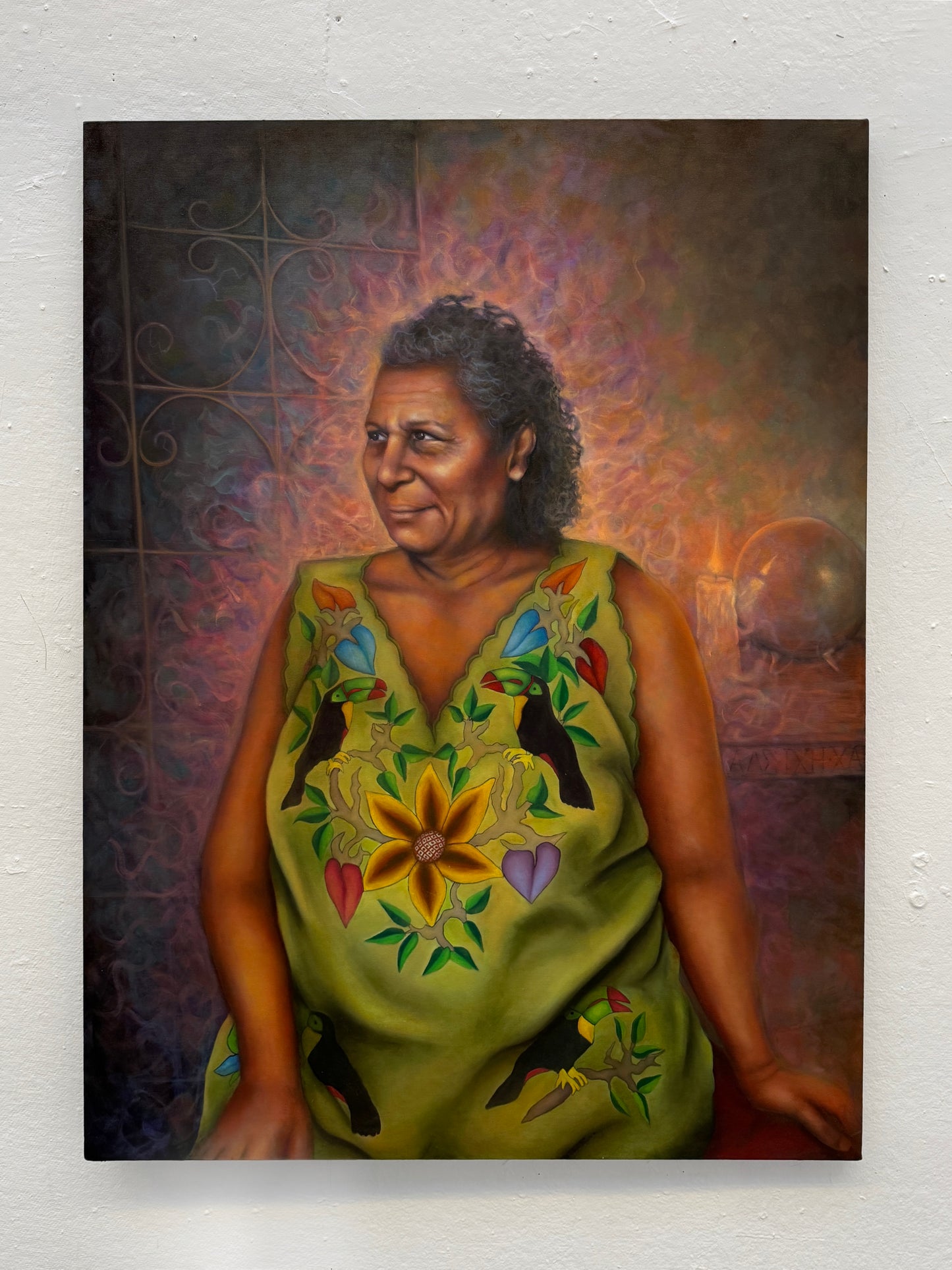
My work dismantles colonial instruments of perception, what we are taught as truth, and what gets suppressed in the process. The camera (the document, the reproducible fact) the surface of a moment captured without the interference of feeling — is the ultimate expression of a western epistemology that measures surfaces and imposes itself as truth. My paintings proceed from a different understanding: that felt experience, memory, and spiritual perception yield a more accurate account of reality than optics ever could, and that rendering a moment in its true magnitude is not sentimentality or fantasy but precision and correction. This is not a stylistic preference but an epistemological commitment.
Abandoning photographic reference was the same decolonial act as learning to see myself through my own eyes. It meant evicting a way of knowing that was never mine to begin with. Growing up Mexican and impoverished in a predominantly white town in Florida, I had learned to disappear into an environment that recognized only a very narrow bandwidth of human experience. I concealed my heritage, survived leukemia at seventeen in near silence, traveled to Mexico to undergo an ayahuasca ceremony with my aunt who is a shaman, and told almost no one. The concealment became habitual, then subconscious, then structural; a condition shared by many whose interiority has been shaped by displacement, poverty, and assimilation into a culture that demands erasure as the price of survival. My practice is not a response to that condition but a departure from it, constructing entirely new perceptual and psychological spaces from what was suppressed rather than from what suppressed it.
This philosophy eventually became architecture. These recurring environments are thresholds opening onto the unknown — spaces of suspension and clarity defined entirely by their exit, by the irreversible passage that awaits on the other side. My father’s recent death arrived into this visual language as its most literal threshold yet. The same framework I had built to hold spiritual transformation and personal reckoning was already waiting to receive grief.
The paintings I am making now extend that language into its most intimate register yet. What personal mythology makes possible is exactly this, the capacity to receive the full weight of an experience and render it in its true magnitude rather than its surface appearance. This is not idealization. It is the same epistemological commitment I began with, applied now to its most personal subject. I am seeing clearly, perhaps for the first time, through a lens that is entirely my own.